Futures
Reel vs Real : Surrogacy in cinema
by Madhusree Jana
Indian cinema has long explored surrogacy and egg donation, showcasing the social and emotional trials faced by those involved. But these silver screen portrayals often stand in stark contrast to the straitjacket effects of the new laws; provoking discussion on the realities and ethics of surrogacy and egg donation. Let’s take a look at some of the movies and how they represent these practices in the face of the new legislation.
Doosri Dulhan (1983)
The movie follows the lives of Anil and Renu, a childless couple. Renu miscarries and finds out she will not be able to have a child again. Her husband Anil doesn’t want to adopt, so Renu suggests they hire a sex worker as a surrogate mother. Enter Chanda, who develops a close relationship with Anil. As time passes, Chanda forms an unexpected bond with the unborn child. When the due date approaches, Renu grapples with her feelings of insecurity and attachment.
❌ Under the Surrogacy (Regulation) Act, 2021, the surrogate relinquishes all rights to the child and must hand over the child to the intending couple after childbirth. The surrogate also has to undergo strict physical and psychological evaluations to be deemed fit to be a surrogate.
Share

Dasaratham (1989)
In this Malayalam movie, Rajiv Menon, a wealthy and aimless alcoholic, wants to have a child without marrying or adopting. Advised by a doctor, he finds a surrogate, Annie, to carry his child through traditional surrogacy. Initially indifferent and financially motivated, Annie becomes emotionally attached with the baby during pregnancy. Despite Rajiv’s care and preparation for fatherhood, Annie refuses to part with the child after birth.
❌ The Assisted Reproductive Technology (Regulation) Act, 2021 and the Surrogacy (Regulation) Act, 2021 do not allow single men to have children through surrogacy or IVF. At the same time, traditional surrogacy isn’t allowed in India, only gestational surrogacy is allowed in which surrogate cannot be genetically linked with the child and she cannot be compensated. Under the new laws, the surrogate is only entitled to the reimbursement of medical costs and a 36-month health insurance.
Share

Filhaal (2002)
The movie revolves around the friendship between two women, Rewa and Sia. When Rewa faces fertility issues after marriage, Sia offers to be their surrogate. Rewa and her husband accept the offer after initial hesitation and emotional turmoil. Throughout the pregnancy, tensions arise as Rewa struggles with jealousy and frustration for losing out on the experience of pregnancy. However, when Sia gives birth to a baby girl, she fulfils her promise and hands the child to Rewa, mending their bond.
✅ In the movie, Sia’s altruistic offer to become a surrogate for her best friend Rewa depicts a form of surrogacy allowed under the Surrogacy (Regulation) Act, 2021, where the surrogate can be known to the intending parties without financial compensation. However, finding a surrogate who is willing to carry a child without compensation is challenging in real life due to the significant physical and emotional labour involved.
Share

Chori Chori Chupke Chupke (2001)
This movie explores surrogacy through a wealthy couple, Raj and Priya, facing infertility. They resort to traditional surrogacy (where the surrogate's own gametes are used), and secretly hire Madhubala (Preity Zinta), a sex worker, to be their surrogate. The film highlights the emotional turmoil involved as Madhubala, initially motivated by money, develops a bond with the unborn baby and struggles with the thought of giving it away to the couple.
❌ The Surrogacy (Regulation) Act, 2021 only allows gestational surrogacy, which means the surrogate’s gametes cannot be used to create the embryo. In the movie, Madhubala is financially motivated; however, the new law only allows altruistic surrogacy and does not permit compensation to surrogates.
Share

9 Nelalu (tr. 9 Months)(2000)
After an accident leaves her husband with a severe brain injury, needing expensive surgery, Savitri finds herself in a tough financial spot. She agrees to undergo artificial insemination to become a surrogate mother for a wealthy couple, who agree to fund her husband’s surgery in exchange.
The movie portrays societal stigma
associated with IVF and surrogacy, and the emotional turmoil a woman has to endure when carrying a child for someone else. The movie opens a public debate on surrogacy,
and also addresses the misconception that surrogacy involves sexual activity.
✅ Savitri’s decision to become a surrogate out of financial necessity resonates with many women whose socioeconomic realities drive them toward surrogacy. The movie aligns with the current legal framework, which only allows gestational surrogacy, involving artificial insemination and mandating no genetic link between the surrogate and the child. By portraying surrogacy as a complex and emotionally charged issue, 9-Nelalu provides a narrative that is relevant and echoes contemporary debates on surrogacy in India.
Share

Vicky Donor (2012)
The movie explores the theme of sperm donation through Vicky, a carefree young man who becomes a sperm donor for a fertility clinic for its financial incentives. The movie sheds light on the social stigma surrounding sperm donation, with Vicky initially hiding what he does and facing ridicule. The story takes an unexpected turn when Vicky’s wife, Ashima, can’t conceive, eventually forcing Vicky to reveal his career as a sperm donor. Despite initial backlash, Ashima realises Vicky’s donations have brought happiness to many families, and comes to terms with it.
❌ The ART Act, 2021 strictly regulates gamete donation in India. It has outlined clear guidelines on the eligibility criteria, screening and recruitment procedure of donors and number of donations. For example, the Act says that all gametes from a single donor must be reserved for only one recipient, unlike Vicky, who repeatedly donates sperm to multiple recipients. Also, like surrogacy, egg donors and sperm donors and not allowed to be compensated under the Act.
Share

I am (2010)[Afia]
'Afia', part of the anthology film, ‘I am’, explores the journey of Afia, a woman in her mid-30s.
After her husband leaves her for another woman, Afia decides to pursue motherhood through IVF with donated sperm. She meticulously chooses Suraj as her sperm donor and insists on meeting him, much against the clinic’s rules. Afia meets Suraj, but their interaction is awkward. She goes ahead with the IVF procedure, and offers Suraj a gift as a thank you gesture, which Suraj politely refuses and gives Afia his contact number instead.
❌ The ART Act, 2021 allows for both anonymous and directed donation (known donor), but with specific regulations for each. While single women are allowed to pursue motherhood through IVF, the recipients in reality, have limited access to the donors’ information. The ARTA requires ART banks, where gamete donors are screened and recruited, to maintain a registry with detailed information (excluding identity) accessible to recipients.
Share

Mimi (2021)
This movie tackles the emotional journey of a young woman, Mimi, who becomes a surrogate mother for an American couple, John and Summer, to pursue her dream of
becoming a Bollywood actress.
The film portrays a commercial surrogacy agreement, where Mimi is financially compensated for carrying the child. However, the situation becomes complicated when prenatal tests suggest the baby might have Down syndrome.
John and Summer, unwilling to raise a child with special needs, abandon the surrogacy contract and leave India. As Mimi navigates through the ups and downs of pregnancy, she forms a deep bond with the unborn child, leading to emotional conflicts and ultimately redefining the meaning of family.
❌ Mimi's story diverges from the regulations outlined in the Surrogacy (Regulation) Act, 2021, in several ways. The Act mandates mandatory counseling for all parties involved, which could have potentially prepared John and Summer for the possibility of a child with special needs. The Act also requires a written agreement outlining responsibilities in such scenarios, which could have provided clarity and legal recourse for Mimi.
Share

Good Newwz (2019)
This film is a comedic take on in vitro fertilization (IVF). Two couples- Varun and Deepti Batra and Honey and Monika Batra, who share the same surname, seek parenthood through IVF treatment. But a hospital mix-up results in the sperm samples being swapped. Both couples are initially furious upon learning of the mistake. As the pregnancies progress, tensions rise, but Deepti and Monika eventually bond over their shared experience.
❌ However, the ART (Regulation) Act 2021 imposes strict protocols to prevent errors in handling sperm and eggs. Unlike in the film where the doctor faces no legal repercussions, the ART Act ensures accountability among clinics and medical professionals for negligence. Violations could result in penalties, including fines ranging from 5 lakh rupees to 10 lakh rupees for initial contraventions and, for subsequent offenses, a prison sentence of at least 3 years and up to 8 years, along with fines between 10 lakh rupees and 20 lakh rupees.
Share
Google Baby (Zippi Brand Frank, 2009)
 .
The documentary begins with a statement:
“…Now all one needs is a credit card. Instructions can be found on YouTube.”
Over the next hour, we watch that process unfold from suburban homes in the U.S. to fertility clinics in India and back offices in Tel Aviv. The film traces the transactional chain through which families are created—across borders, through screens, and with credit cards.
An Israeli man, unable to have a child with his partner through conventional means, takes his sperm, selects an egg donor via an online donor platform, and has it implanted in a woman in Gujarat, India. The woman, a surrogate recruited through a fertility clinic run by Dr. Nayna Patel, lives in a dormitory for the duration of the pregnancy, along with other women whose bodies have been contracted to gestate someone else’s future child.
Egg donors, surrogates, clinics, and clients thus form a chain that turns conception into a cross-border transaction.
Each participant in this supply chain has a reason. For some, it’s profit. For others, it’s survival. Kat, an American egg donor and mother of two, uses the money to pay for home repairs. Her Indian counterpart uses hers to build a house from scratch. They live continents apart, in radically different circumstances but there is something oddly similar: reproductive labour becomes a path for family advancement.
“The business aspects of the reproduction industry are intriguing as well as frightening… With no existing legal barriers to overcome and lots of money to be made, the human reproduction industry is steaming ahead.”
-Zippi Brand Frank at Rocky Mountain Women's Film Festival Screening 2010
Google Baby shows us that surrogacy is not just an act of care. It is labour. It is logistics. It is management. The surrogate mothers live under supervision, follow daily routines, and are monitored for compliance.
The documentary captures the outcome - a gay couple starts a family. A donor pays off debt. A surrogate paints the walls of her new home. But it also refuses to look away from what this costs, and who does the paying.
In an era when assisted reproduction is increasingly accessible yet remains deeply uneven, Google Baby prompts viewers to reflect on the ethics of reproductive labour, the power imbalances shaped by global markets, and the ways in which technology both enables and complicates our most fundamental human experiences.
Fertile Grounds of Extraction
By tracing the often invisible work of egg donation, hormone collection, and IVF procedures she reveals a relational world where science is entangled with hierarchy, and where reproductive labor becomes a site of both care and structural inequality.

One of the book’s most striking historical case studies centers on the collection of pregnant women's urine in 1970s and ’80s Kolkata.
In order to extract Human Chorionic Gonadotropin (hCG), a crucial hormone used in IVF protocols, pharmaceutical companies needed massive quantities of urine. After an unsuccessful attempt to procure the same from middle-class women, it was the 'poor, working class neighbourhood of North Calcutta' that was found to be "fertile grounds for collection". In return, donors were not paid wages but given a “gift”, a tin of Horlicks ( later, a household item like a steel plate or bucket).This program was framed as “mothers for mothers”, appealing to a 'sense of generosity'. This narrative of altruism, concealed the structural inequalities at play. Perhaps the value of the gift (a Horlicks tin) was kept low to ensure that the donor-women continued to perceive their contribution as ordinary.
By avoiding formal wages and offering modest compensation instead, the program reinforced a sense of 'giving', masking the extent to which womens' bodies were fuelling a commercial and scientific enterprise. The case thus illustrates how class shapes access to recognition and compensation.
Rather than framing assisted reproductive technologies as 'empowering', Substantial Relations documents how they are experienced unevenly.
Surrogacy & Assisted Reproductive Technology (ART)
These laws don't just affect people currently trying to have babies. They reflect broader questions about who gets to make decisions about family planning, what kinds of families are recognized and supported, and how medical services should be regulated.
If you're curious about how these regulations work, here's a must-see animation by Justice Adda.
Myth or Fact?
Test your knowledge about Surrogacy and Egg Donation in India
You Scored:

You've completed the quiz on Surrogacy and Egg Donation laws in India.
For the price of a smartphone
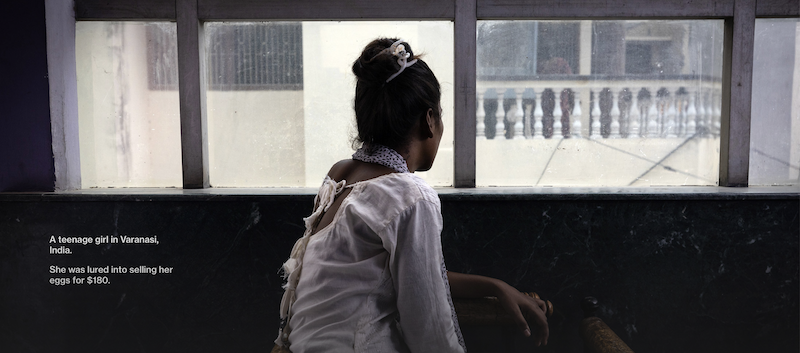
🎧 This powerful report from Bloomberg unpacks the quiet exploitation at the heart of the reproductive industry—and what it costs those at the bottom of India’s caste and class hierarchies.
The girl in this story doesn’t know her own age. Her mother doesn’t either. That simple, unsettling fact should make us stop and take notice. But the system doesn’t hesitate; it adapts. A fixer steps in. The clinic moves forward with the procedure.
The story holds a mirror to how entire industries are built on the backs of those whose lives are precarious and undocumented, where the desperation of a ₹15,000 smartphone meets the demand of a ₹200,000 fertility treatment.
It tell us how the labor of a poor girl’s body can be repackaged, anonymized, and sold under the language of "hope" and "family building."
Beyond scientific progress, this story forces us to confront the social costs of medical miracles.
It helps us ask: Who is allowed to dream? And who has to sell that dream, piece by piece?
The clinic in Varanasi is just a small part of a much larger picture of inequality that makes stories like this both possible and disturbingly ordinary.
Services like egg donation depend on the labour of women with limited economic means, reminding us that systems of care are built on class-hierarchies.
Whether paid or unpaid, legal or outlawed, visible or hidden, their labour sustains families, communities, economies.
In this 14-minute short film Juice, the kitchen becomes a furnace. While the men sit in comfort, the women serve constantly. The film simmers with unspoken tension, until one woman finally refuses to contain the heat.
women's work and worth.