




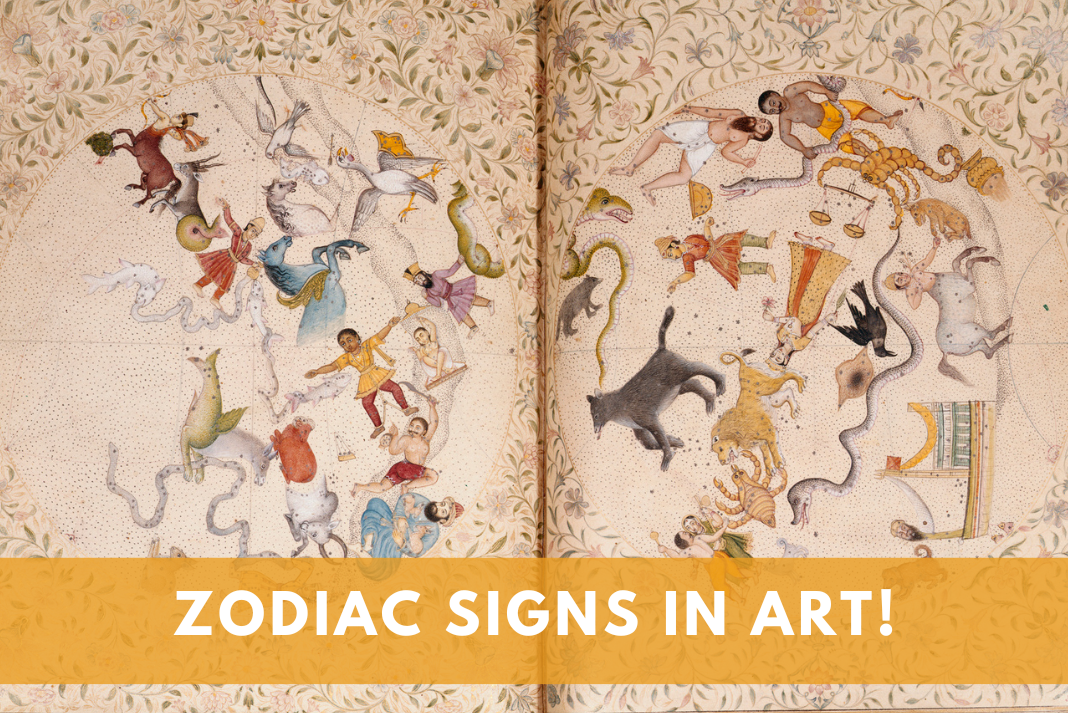
Zodiac signs are some of the most recognisable iconography in art. Naturally, they feature in manuscripts about astrology and astronomy. But interestingly enough, they are also found in a range of other material including paintings, architecture, decorative art, and coins.
As we come to the end of 2023, we thought its an apt time to to revisit the 12 steadfast friends who have accompanied us this year (and every other)! In this article, the 12 signs of the zodiac descend from their celestial abode to grace us in the form of art. Let’s take a look:

Signs of the Zodiac, Sarvasiddhāntatattvacudamani (The Jewel of the Essence of All Sciences)
The Sarvasiddhāntatattvacudamani or The Jewel of the Essence of All Sciences was a manuscript produced in the Sikh Empire in 1840. It was commissioned by Maharaja Kharak Singh. The manuscript, with its tantalising name, is essentially a work that combines knowledge of astronomy from Hindu, Islamic and European systems. One can spot the familiar icons of the scales for Libra, the archer for Sagittarius, and the fish for Pisces. But for Gemini, the artist has chosen the Vedic form of the sign, Mithuna or lovers (see bottom of right page). It also includes other constellations from Western systems like Ursa Major (bear) and Lepus (hare). Can you spot your zodiac sign here?

Tray with Zodiac Signs
This is a tray from 19th century Rajasthan. Executed in brass, the tray has concentric bands of decoration carved into the metal. The central figure is of Surya the Sun god in his chariot. The next band consists of the 12 zodiac signs in their Vedic versions. Starting at the top and moving clockwise, they are Vrishchika (scorpio), Tula (Libra), Mesha (Aries), Vrishaba (Taurus), Mithuna (Gemini), Karkata (Cancer), Simha (Leo), Kanya (Virgo), Meena (Pisces), Makara (Capricorn), Kumbha (Aquarius) and Dhanu (Sagittarius). Most of the iconography is similar to its western counterpart except for Capricorn whose substitute is Makara, a mythical creature. The meaning of outermost band is still uncertain, but many of the circles that make up this row depict a kingly figure riding or accompanying an animal.
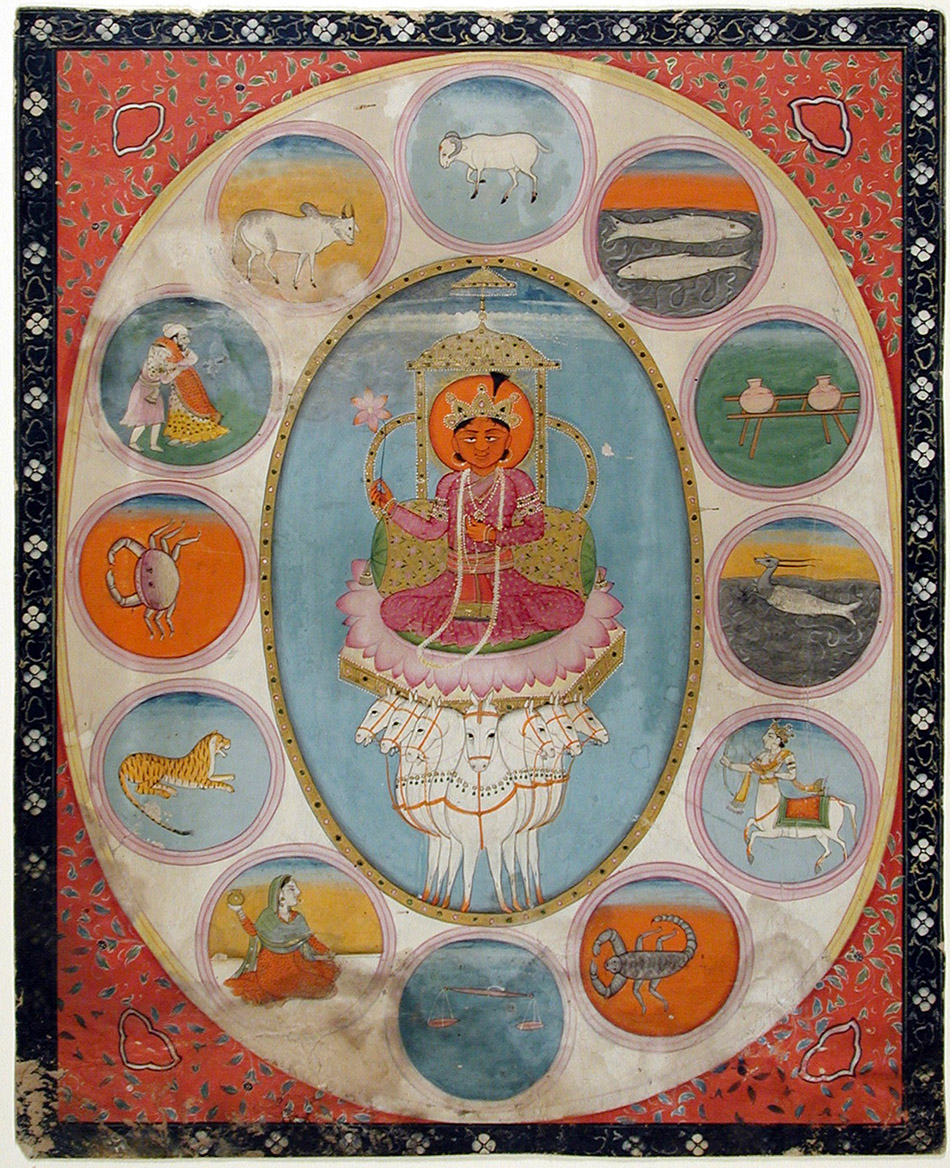
Surya surrounded by the signs of the Zodiac
This Kangra School painting from circa 1830 by an unknown artist follows the same design as the tray, the central figure of Surya surrounded by the zodiac signs. However, there are some modifications in the iconography. Human figures are avoided wherever possible, as in the case of Libra and Aquarius. For Leo, a tiger replaces the traditional lion, perhaps making it more suitable to an Indian context. Interestingly the sign for Capricorn is not the makara as seen on the tray, but instead a hybrid of goat and fish known as Sea Goat. This creature has been associated to the Capricornus constellation since Babylonian times! The painting shows a curious mix of Indian and foreign influences.

Zodiac coins issued by Jehangir between 1619-1625.
Under Mughal rule, coins typically featured the emperor’s name on one side and the mint, month, and year of the coin. Jehangir came up with the fascinating idea of replacing the month with its zodiac sign. Most of these were minted in gold at Agra between 1619-1625 and are the only coins in India that feature astrological signs! Notice how the coin for Leo has a sun in the background? This seems to be a conscious move to replicate the Mughal flag which features a lion in front of the rising sun.
However, when Jehangir’s son Shah Jahan ascended the throne, he banned these coins for their use of figural decoration and decreed that anyone who used them would be given the death penalty! Odd since painting and manuscript ateliers still flourished under his rule!

Architecture that can help you calculate the zodiac month
Constructed in the 14th century, the Vidyashankara Temple in Sringeri, Karnataka has some subtle references to the zodiac! Its pillars, known as Rashi Stambhas (Zodiac Pillars) are an impressive example of the use of astrology in ancient architecture. Because of its construction, in different months, shadows are created on the pillars corresponding to the current month. This helped temple priests calculate auspicious days in the calendar. Look closely and you’ll find the sign for Scorpio etched into the stone.
You can also spot zodiac tiles at the Jantar Mantar in Jaipur!

Modern representations of the zodiac!
Undoubtedly, the zodiac has found favour with artists in the past. But even Modern and Contemporary artists have found inspiration in the 12 signs. This painting by Arpita Singh is one from a 12-part series based on the zodiac. Executed in watercolour and acrylic on paper, it shows the Gemini Twins, both women, as wordsmiths. Singh moves away from the dominant perception of Gemini Twins as alluring beauties. Instead, she shows them as wise women, with an open book above them. The lotus imagery in the painting could be a reference to Buddha, the enlightened one, who is often depicted on a lotus throne. Want to see Arpita Singh’s interpretation of your sign? Check out her entire series in the MAP collection here.
